|

|
Amphidiploid Dwarf and Median
Bearded Irises
|
 When
I. pumila is crossed with a 48-chromosome bearded iris (such
as a modern tall bearded), the result is a plant with two sets of 8
chromosomes from I. pumila and two sets of 12 chromosomes from
the other parent. This configuration (known as an amphidiploid) is
generally fully fertile. The modern standard dwarf bearded irises
virtually all belong to this 40-chromosome fertile family. Amongst
wild irises, the species I. lutescens in its various forms has
essentially the same chromosome makeup, and is thus also part of the
same fertile family. Other apparent members of this family are I.
bicapitata and I. subbiflora. I.
sp. aff. reichenbachii ex Vardar
Gorge probably belongs in this group
as well.
When
I. pumila is crossed with a 48-chromosome bearded iris (such
as a modern tall bearded), the result is a plant with two sets of 8
chromosomes from I. pumila and two sets of 12 chromosomes from
the other parent. This configuration (known as an amphidiploid) is
generally fully fertile. The modern standard dwarf bearded irises
virtually all belong to this 40-chromosome fertile family. Amongst
wild irises, the species I. lutescens in its various forms has
essentially the same chromosome makeup, and is thus also part of the
same fertile family. Other apparent members of this family are I.
bicapitata and I. subbiflora. I.
sp. aff. reichenbachii ex Vardar
Gorge probably belongs in this group
as well.
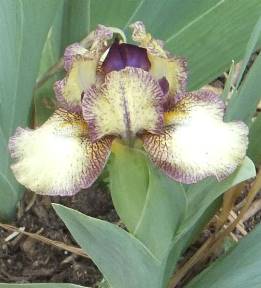
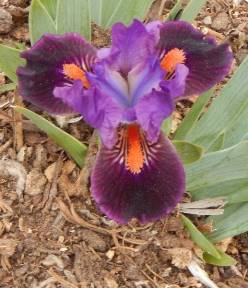
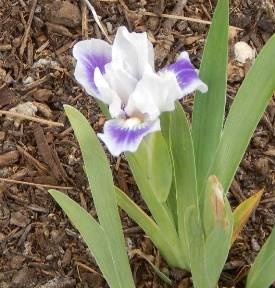
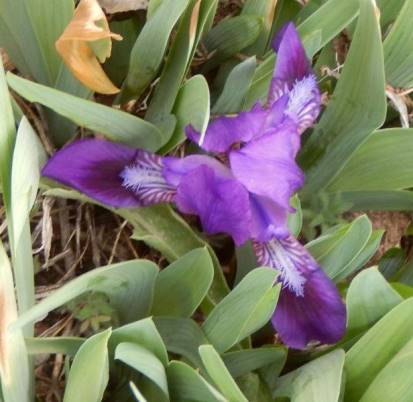
Many fine new SDBs are produced each year, so
this family is going strong, second only to the tall beardeds in the
popularity and attention it receives.
The family can be expanded by making new
pumila x 48-chromosome bearded iris crosses. The original
crosses that launched the SDBs involved a number of forms of I.
pumila along with a range of TBs from the mid-20th century. It
might be valuable to use different, modern TBs and BBs as parents,
and to use the 48-chromosome
medians as well. If the TBs are used,
the seedlings will likely be larger than ideal for SDBs, but if the
medians are used, they are likely to be smaller, even falling in the
MDB range. Ben Hager produced a number of nice MDBs via this route,
and in fact many modern MDBs are of this sort, either derived from
Hager's lines, or simply short selections from SDB breeding. Still,
the potential here is not exhausted by any means.
I want to bring different species into the
mix, and the primary reason for doing so is to improve the options
for the MDB class.
In Hager's time (1960s through 1990s or so),
most widely grown MDBs were the result of crossing SDBs with I.
pumila. These had a very distinct character: early, very prolific
bloom, with a daintiness instantly distinguishable from the SDBs. You
may be familiar with old favorites of this type, such as 'Alpine
Lake' and 'Zipper'. Unfortunately, most of these had very little
fertility, being unbalanced tetraploids with three pumila sets and
only one TB set. Hager thought that improvement in the MDB would only
come if they were fertile and could be bred with one another for
multiple generations, like the SDBs.
He had misgivings about just selecting small
SDBs, however, skeptical that they could preserve the distinctive
qualities of the MDBs. Interestingly, this is exactly where the
hybridizing world has gone in recent decades. Almost all new MDBs
introduced today are just small selections from SDB lines. People
seem to like them and grow them (I do myself), but I know I'm not the
only one who feels the line between MDBs and SDBs has blurred a
little too much. Many of these modern ones are right at the top
height limit of the class, not really distinguishable from SDBs
without a ruler, and in some cases not particularly early blooming,
which has been one of the attractions of the MDBs
historically.
Hager's idea was to work within the
40-chromosome family, but to use other-than-TB types and species with
I. pumila to ensure daintier flowers. In particular, he
advocated I. aphylla and the aphylla-derived tetraploid
MTBs. MDBs from this kind of breeding are fertile with one another,
and also fertile with the SDBs, so the hope was that one could take
advantage of advancements in SDBs for MDB breeding without losing
either fertility or daintiness.
Hager had nice results from this approach,
including favorites like 'Gizmo' and 'Libation', among quite a few
others. But subsequent hybridizers largely left this project behind,
in favor of the SDB-only approach, which gives more immediate
results.
Now, however, we have some opportunities to
revisit this program. The tetraploid MTBs have improved a great deal.
Using them directly with I. pumila to produce dainty MDBs
seems promising, and is a largely unexplored area. Also, there are
other even smaller tetraploid species that can be used in place of
I. aphylla. I. schachtii is available now, as is I.
junonia, and tetraploid forms of I. reichenbachii if one
can find them. Any of these crossed with I. pumila should give
small MDBs that are fully fertile with SDBs and their modern MDB
offspring.
There are also some 40-chromosome species of
MDB or SDB size that have not been used significantly in modern SDB
breeding, including Ii. lutescens, subbiflora, and
bicapitata.
So I'm on my way to creating a mixing pot
with these three ingredients:
1. Seedlings from I. pumila
crossed with I. aphylla, tet MTBs (or small BBs), I.
schachtii, I. reichenbachii, or I. junonia - for
daintiness, early bloom, and "wildflower charm" for those who
appreciate such things
2. SDBs and MDBs from SDB breeding - for
refined form and substance and diverse color patterns
3. Ii. lutescens, subbiflora,
bicapitata - just to learn if they have any valuable
distinctiveness to contribute.
I don't expect a project like this to make
any dent in the popularity of modern SDB-type MDBs, but it will be
fun to see what can be done.
Progress to Date
These plans are going well. I've been using
an I. subbiflora raised from seed (S004-01), and my own
seedling of I. aphylla x I. pumila (S006-01) in crosses
with SDBs and PPTT MDBs. S006-01 is particularly interesting,
being no taller than a typical pumila, but with a stalk branched at
the base, with typically two buds per branch!
A major development for this line are
seedlings (S026-01 and S026-02) from crossing the tetraploid I.
reichenbachii from Mt. Vikos, Greece, with I. pumila
'Royal Wonder'. These have turned out to be about pumila size (4
to 5 inches), dainty, with 1 or two buds per stem, and blooming in
pumila season. These should be great for size reduction in this
family.
The cross of 'Kaching' X I. subbiflora
was a bit disappointing, as nothing is MDB sized when blooming on an
established clump, and proportion is poor overall. Some have a nice
deep red color, however. There were a few with somewhat smaller,
proportionate blooms held well out of the foliage, and these I have
kept for future work. Although much taller than I had hoped for, I do
think they have an interesting look.
'Eye of the Tiger' X S006-01 also produced
plants that are more SDB size than MDB, with proportion issues and
overlarge flowers down in the foliage. Some of them, though, gave
daintier blooms with a more slender effect, and I have kept
these.
'Tic Tac Toe' X I. pumila 'Wild
Whispers' shows that simply using pumila is no guarantee of small
size. Most of these look like MTBs, although early blooming and more
toward the lower end of the MTB height range. I saved the smallest of
these (at about 12 inches) to look at further.
What I've learned from this first round of
crosses is to choose the smallest parents possible if hoping for
MDBs. I will probably not use SDBs in the future; they were just what
I had blooming at the time. I'm also focusing on selecting for very
small pumilas with small foliage.
Further Reading
Standard
Dwarf Bearded Irises: A Success
Story (AIS blog)
Dwarfs
for Every Garden
(AIS blog)
The Miniature Dwarfs:
A Hybridizer's Survey of the Class, its History, and its
Potential
What is a
Dwarf Bearded Iris? A Brief History of the Shifting Definition of the
Class
Hybridizing
with Iris reichenbachii (AIS
blog)
Iris
lutescens: The Dwarfs that Time Forgot
(AIS blog)
Narrated Powerpoint presentation
Dwarf
Bearded Irises: The Three Types of MDBs
on Youtube
The
Classic MDBs (AIS blog)
Ben
Hager's Master Plan to Save the MDB Class
(AIS blog)
Miniature
Dwarf Bearded Irises: A Starter Kit
(AIS blog)
Understanding
the Historic Dwarf Bearded (DB) Class
(AIS blog)
Hall of Fame
Greenspot (Paul Cook, R. 1951).
Seedling 2148. SDB, Height 10" (25 cm), Early bloom season. White
self green spot on falls. Cook 10942 X yellow I. pumila.
Honorable Mention 1951, C-D '59, CDM 1968. Longfield 1951.
Although there are any number of those
first-generation SDBs from the pioneering TB x I. pumila
crosses that might be singled out as classic achievements, I have
selected 'Greenspot' because of its enduring popularity as a garden
plant and its use in many different types of breeding over the years.
It showed off the potential of the pumila spot pattern in
median breeding and modeled the flower and plant proportion desirable
for the SDB class.
Lenna M (Earl Roberts, R. 1964). Sdlg.
64R13. SDB, 10" (25 cm), E. Color Class O1P, S pink; F pink, deeper
beige spot, white-pink border; white beard tipped red. (TB orchid
sdlg. x 'Barium Gold') X Zickler sdlg: (('Twilight Sky' x white
pumila) x ('Desert Song' x white pumila)). Roberts 1966.
Early on in SDB breeding, it was thought that
the recessive TB color patterns, such as the plicata pattern and the
tangerine pinks, might not be possible in the SDB class. I have
chosen 'Lenna M' as an example of an early breakthrough in this area;
it was quite a sensation in its day as a pink SDB and was much used
in breeding. Although it would be a number of years until pink and
orange SDBs improved enough to win top awards, these early
accomplishments laid the groundwork for the great color variety we
have today.
Libation (Ben Hager, R. 1974).
Seedling AHD2541B . MDB, height 5" (13 cm), Mid to Late bloom season.
Standards wine red; falls deeper wine red, darker spot area; yellow
beard. 'Prodigy' X ('Scale Model' x 'Brownett'). Melrose Gardens
1975. Caparne Award, 1979.
I've included 'Libation' as an early and
popular example of Ben Hager's work in producing MDBs from combining
I. pumila with his aphylla-based tetraploid MTB lines.
MDBs from this type of breeding are fully fertile with SDBs, but
retain a natural daintiness appropriate to the miniatures. It is
partly because of such work that so many nicely formed and varied
MDBs are available today.
Chubby Cheeks (Paul Black, R. 1984).
Seedling 824E. SDB, height 12" (30 cm), Early bloom season. Standards
white ground, stitched light violet, greyed chartreuse band; falls
white ground, stitched violet around outer portion, widely banded
greyed chartreuse; pale violet beard tipped tangerine in throat;
ruffled; pronounced sweet fragrance. Sdlg. 824E: (B80-20: ('Concord
Touch' x 'Daisy') X 'Soft Air'). Mid-America Iris Gardens 1985.
Cook-Douglas Medal, 1991.
The wide-petaled form of this SDB has
transformed the class. It is arguably the best SDB breeder ever
produced, with a multitude of superior offspring introduced over a
span of more than two decades.
Gallery
MDBs
|

|

|

|
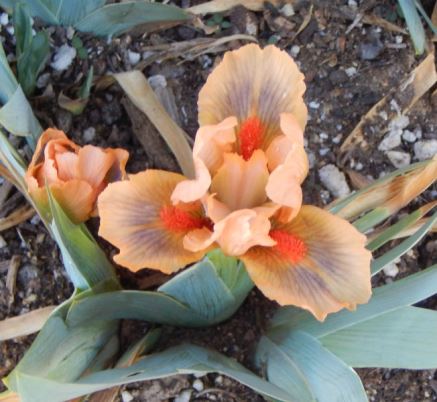
'Dollop
of Cream'
(Black, 2006)
|
'Icon'
(Keppel, 2008)
|
'Keeno'
(Johnson, 2009)
|
|

|

|
'Miniseries'
(Keppel, 2011)
|
'Mini
Stitch'
(Sutton, 2016)
|
'Pearly
Whites'
(Black, 2014)
|
SDBs
|

|

|

|
'Abuzz
with Charm'
(Coleman, 2013)
|
'Alaia'
(Johnson, 2018)
|
'Arson'
(Keppel, 2016)
|
|
|

|
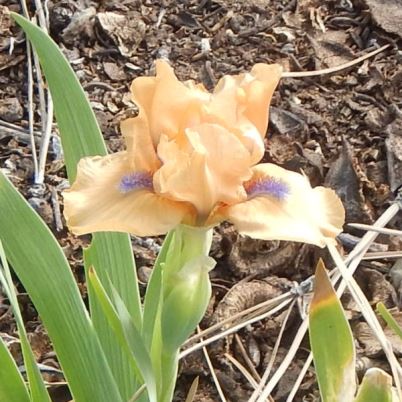
'Bluebeard's
Ghost'
(Black, 2006)
|
'Decorum'
(Keppel, 2012)
|
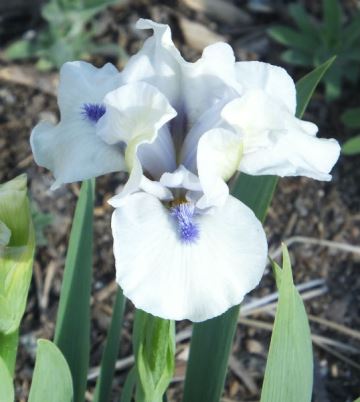
'Eye of
the Tiger'
(Black, 2008)
|

|

|

|
'Heart Stopper'
(Coleman, 2013)
|
'Kaching'
(Black, 2009)
|
'Pepi'
(Sutton, 2017)
|

|
|

|
'Pussycat
Pink'
(Black, 2006)
|
'Raspberry Ice'
(Keppel, 2012)
|
'Tuned In'
(Johnson, 2016)
|
Species
|

|

|

|
|
I.
lutescens 'Bride'
|
I.
lutescens 'Path of Gold'
|
I.
lutescens S019-01
|

|

|
|
|
I.
lutescens campbelli
|
I.
subbiflora S004-01
|
|
|
Tom Waters Seedlings
|

|

|

|
|
S006-01
(I. aphylla X I. pumila)
|
S026-01
(I. reichenbachii ex Mt. Vikos X I. pumila
'Royal Wonder')
|
S026-02
(I. reichenbachii ex Mt. Vikos X I. pumila
'Royal Wonder')
|

|

|

|
|
S027-07 ('Kaching' X I.
subbiflora)
|
S027-21 ('Kaching' X I.
subbiflora)
|
S028-02 ('Eye of the Tiger'
X S006-01)
|

|

|

|
|
S028-03 ('Eye of the Tiger'
X S006-01)
|
S028-19 ('Eye of the Tiger'
X S006-01)
|
S029-05 ('Tic Tac Toe' X I.
pumila 'Wild Whispers')
|
Plant
List
The list below shows the name of each plant I
currently grow for breeding purposes, the source, and the year
acquired.
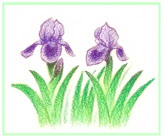
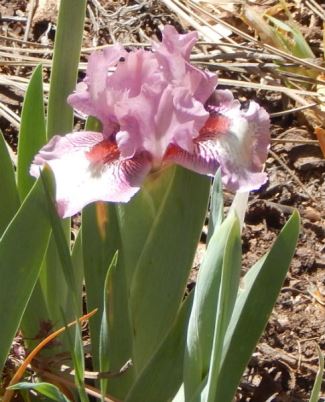
Illustration: 'Gizmo'
(Hager '76): an MDB from I. aphylla breeding.
Tom
Waters
September 2010
updated April
2023
Unless otherwise noted, all text
and illustrations copyright Tom Waters and all photographs copyright
Tom or Karen Waters. Please do not reproduce without
permission.